Most of us judge a chatbot solely on whether it answers.
If it does, it’s doing the job it’s supposed to.
Needless to say I don’t think that, or I wouldn’t be writing this.
So, a few weeks ago I ran tests on the website assistants of several five star luxury properties.
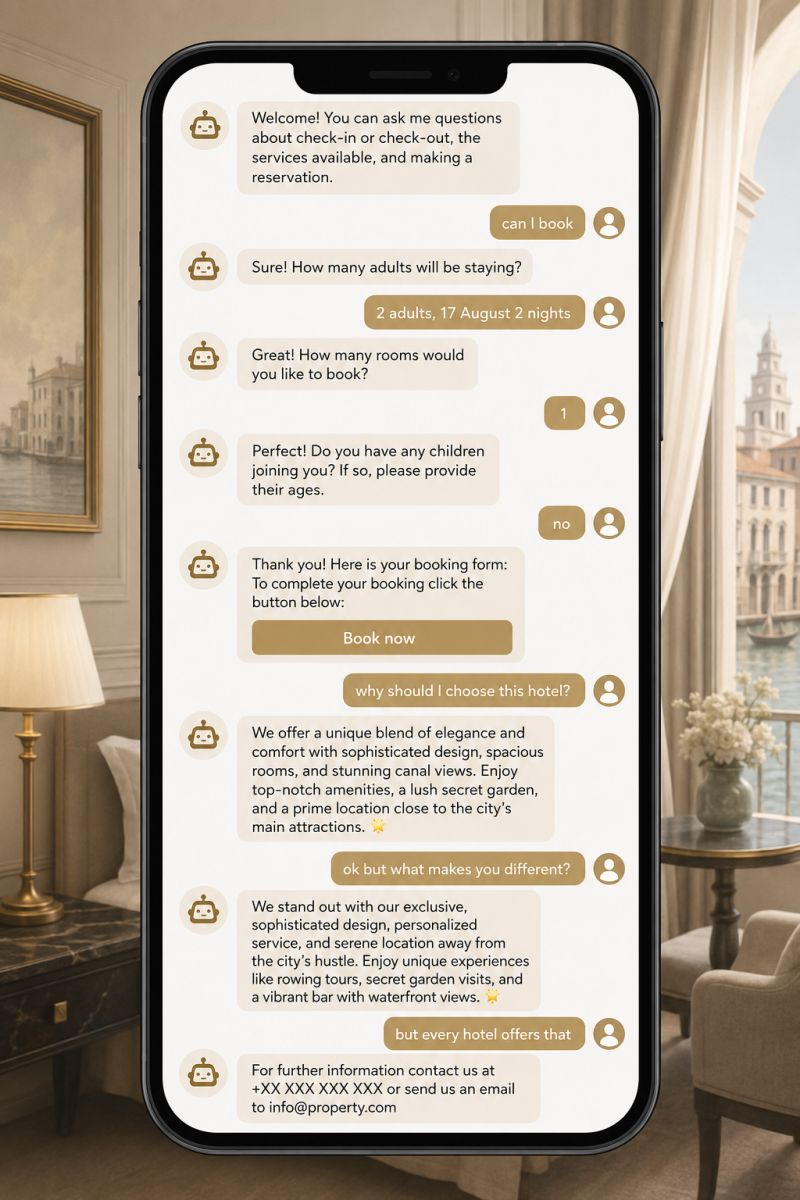
The conversation below is one of them, and it’s a fair summary of most of the others.
The hotel sits in one of those destinations everyone recognises from a single photograph, and I’m keeping it anonymous because the interesting part has nothing to do with that particular property and everything to do with what we all quietly expect from this kind of tool.
I want to be blunt about where this is going before we start.
There is nothing in that conversation worth defending, including the half that looks like it went fine.
The booking that never happens
Bot: Welcome! You can ask me questions about check-in or check-out, the services available at the hotel, and making a reservation.
Me: can I book?
Bot: Sure! How many adults will be staying?
Me: 2 adults, 17 August 2 nights
Bot: Great! How many rooms would you like to book?
Me: 1
Bot: Perfect! Do you have any children joining you? If so, please provide their ages.
Me: no
Bot: Thank you! Here is your booking form: To complete your booking click the button below: Book now
Read that back as a guest rather than as the person who signed off on the software. I typed my dates, my headcount and my room count into a chat window, one field at a time, in response to four separate questions.
On the same website there is a booking widget where a calendar and two clicks collect all of it, without typing a single word.
So the conversational interface made the easiest part of the process slower than the form it was supposed to improve on.
Then comes the sentence that gives the whole thing away.
“To complete your booking click the button below.”
Nothing was completed.
The bot never checked whether a room was free on the 17th, never told me a rate, never told me what I’d be sleeping in, and never took a booking.
It collected four pieces of information it had no ability to act on, then handed me over to the booking engine, which is the same page the “Book now” button in the header would have opened before I said a word.
What I actually received was a request form with extra steps, delivered in a chat bubble.
That’s the honest description, and any hotel running this setup is paying for a layer that sits between the guest and the booking engine without adding anything on the way through.
Someone will point out that it replies instantly at two in the morning.
Of course it does, that’s the least a piece of software can do, and it tells you nothing about whether the thing is worth having.
What the standard actually is now
An agentic assistant handles that request end to end.
It reads “2 adults, 17 August, 2 nights” as a complete instruction rather than a starting point for four follow up questions.
It connects to the CRS or the PMS, checks live availability for those dates, comes back with what’s free and what it costs, answers whatever the guest asks about the difference between the categories, and takes the payment inside the conversation.
The guest never leaves the chat, and the confirmation arrives before they’ve closed the tab.
Anything short of that is mechanising a process that already worked in three clicks: search, land on the site, submit a request.
This first failure sits on the product side, not the positioning side, and the distinction matters because the two get confused constantly.
No amount of clarity about your brand will let an assistant see your availability.
If your bot can’t transact, that’s a build question and a vendor question, and no rewriting of answers will touch it.
Everything from here on is the other kind of problem, the kind no vendor can fix for you.
The post office clerk register
Look at how the bot speaks in that same exchange.
“Sure!” then a field.
“Great!” then a field.
“Perfect!” then a field.
“Thank you!” then a link.
Four exclamation marks doing the work that warmth is supposed to do, attached to a queue of form questions.
Nobody asked why I was coming, whether I’d stayed before, whether the two nights were part of a longer trip, or whether there was an occasion attached to a mid August weekend.
This is the register of a clerk at a post office counter: polite, efficient at moving you along, and entirely uninterested in you as a person.
It’s a strange register to adopt on the website of a hotel whose entire product is attention.
How the rewrites in this piece work
From here on, every failure comes with the answers I’d have wanted instead, and there’s a rule behind how they’re built that matters more than the answers themselves.
I could write you a beautiful reply to any of these prompts right now, and it would be worthless, because I’d be inventing a positioning on behalf of a hotel I know nothing about.
That’s the same shortcut this whole piece is arguing against.
So each rewrite starts with a hypothetical positioning, stated plainly as an invention, followed by the answer that comes out of it.
Two per failure, drawn from different kinds of property, so you can see how far the answer moves when only the premise moves.
The scenarios are teaching examples.
They are not the real positioning of the hotel I tested, and they aren’t meant to be copied onto your own site.
Read them and find the one sitting closest to your property.
One last warning, because this is where the exercise usually goes wrong.
The variable is the positioning, meaning who the guest is and what the property genuinely delivers.
Tone of voice is a consequence of that, not a substitute for it.
Two hotels with identical positioning and different tones will give you the same answer in different clothes, so dressing a generic reply in a warmer voice leaves you precisely where you started.
Scenario 1, the classic grande dame in a very busy destination. The property has been a hotel for over a century, in a place that receives more visitors every August than it can comfortably hold, and what it really sells is insulation from the crowd the destination is famous for.
The guest is paying to experience a mobbed city as though it weren’t.
Of course, two adults, the 17th and 18th. I have rooms on both nights and I’ll show you the options in a moment. Before I do, is this your first time in the city? I ask because mid August is the busiest fortnight we have, and the difference between a good stay and an exhausting one comes down almost entirely to what time you leave the hotel in the morning, which is something we plan with guests before they arrive. Would you rather look at the quiet courtyard rooms or the ones facing the water?
Scenario 2, a family run property with the owner on site. The owner lives on the property and is present with guests every day, so what’s being sold is a relationship rather than a service standard.
The guest is buying being known rather than being attended to.
Of course. Two adults, the 17th and 18th, that’s noted. Before I look at the calendar, is this your first time with us or are you coming back? Marco, who owns the place, likes to know who he’s welcoming. I have rooms free on both nights and I can show you the rates now, or hold something for a few hours while you decide.
Both versions collect the same four pieces of information in one move instead of four.
Both check availability, because the exchange is pointless if they don’t.
And both ask one question about the guest rather than about the booking, which is the entire difference between a conversation and a queue.
Getting the register right buys you the next thirty seconds.
What you do with those thirty seconds is where the tested bot lost the sale outright.
The “why you” moment
Me: why should I choose this hotel?
Bot: [Hotel Name] offers a unique blend of elegance and comfort with its sophisticated design, spacious rooms, and stunning views of the [landmark]. Enjoy top-notch amenities, a lush secret garden, and a prime location close to the city’s main attractions.
Me: ok but what makes you different?
Bot: [Hotel Name] stands out with its exclusive, sophisticated design, personalized service, and serene location away from the city’s hustle. Enjoy unique experiences like rowing, secret garden tours, and a vibrant bar with waterfront views.
I asked the question that decides the sale, twice, and got the same paragraph with the adjectives shuffled.
Every word of it could be pasted onto the website of any competitor in that city without a single edit, which is the practical test for whether a differentiator is real.
This is the failure worth the most attention, so it gets three rewrites instead of two, one for each kind of property a reader is likely to recognise.
Scenario A, the classic grande dame
The property has been a hotel for over a century and sells continuity, which shows up in fixed rituals, a formal dining room and staff who have been there for decades.
The guest is buying the feeling of stepping inside a tradition that existed before them and will outlast them.
Most people choose us for the continuity. We’ve been a hotel since 1876 and the dining room has been run by the same family for three generations, so the five o’clock service you’d sit down to is the one their grandparents were served. If that’s the kind of stay you’re after, I’d put you in one of the original second floor rooms rather than the newer wing. Shall I hold one for the 17th while you think about it?
Scenario B, casual luxury
The property delivers the material standard of the formal five star hotels nearby, then deliberately strips out the ceremony that usually comes attached to it.
The guest wants the level without having to perform it.
Guests usually pick us because they want the standard without the performance. There’s no dress code anywhere in the building and breakfast runs until half eleven, on the reasonable assumption that you’re on holiday. The beds and the kitchen are at the level of the formal places up the road, minus the ritual. Does that sound closer to what you’re after, or are you leaning towards something more traditional?
Scenario C, family run with the owner on site
The owner lives on the property and is personally present with guests every day, so what’s being sold is a relationship rather than a service standard.
The guest is buying being known rather than being attended to.
The honest answer is Marco, who owns the place and lives here. He does the welcome himself, he’ll sit down with you the first evening to work out your days, and when he books you a table it’s because he’s known that owner for twenty years, not because we have an arrangement with them. You’d get a person rather than a reception desk. Shall I let him know you’re looking at the 17th, so he can write to you himself?
Three answers, three different hotels, and a guest could rule out two of them within about four seconds.
That’s the entire point of the exercise.
An answer nobody can rule out is an answer nobody can choose, which is exactly what the brochure paragraph does: it survives every reader by meaning nothing to any of them.
Notice as well that all three end with a question, so the conversation stays open and the assistant keeps hold of the guest.
If you want the strategic version of this argument, the Blue Ocean approach to hotel positioning is the long form of the same idea: a difference that costs you nobody usually wins you nobody.
None of it counts for much, though, if the assistant walks away the second the guest declines to be convinced.
Which is what happened next.
Folding at the objection
Me: but every hotel offers that
Bot: For further information contact us at [phone number] or send us an email to [email address]
That reply is the most expensive line in the whole transcript.
“But every hotel offers that” is not a complaint and it isn’t the end of a conversation.
It’s purchase friction, the moment a guest tells you they’re still in the room and still want to be convinced, and it’s the exact point where a salesperson leans in.
Being handed a phone number there means the hotel walked away from a sale that was still live, and asked the guest to do the work of restarting it through a slower channel.
Scenario 1, the grande dame. The claim is a century of continuity, and the one thing a competitor cannot buy quickly is time.
You’re right, and most of the properties here do offer all of it. What they can’t assemble at short notice is time: we’ve been a hotel since 1876 and half the dining room staff have been here longer than I have. If you want a new room in a new building with a new team, we’re the wrong choice and I’d rather say so now. If you want the version of this city that existed before it got this busy, that’s what we’re for. What made you start looking at us in the first place?
Scenario 2, casual luxury. The real difference is the absence of ceremony rather than any feature a competitor could simply buy.
You’re right that most places say it, so let me be specific instead. We don’t have a dress code and dinner isn’t at a fixed hour, which the two five star hotels nearest to us both do. That’s the trade off: you lose the ritual, and if the ritual is part of what you want from a trip like this, one of them will suit you better than we will. If it isn’t what you’re after, what’s making you hesitate?
The same two moves are doing the work in both.
Each one names a competitor’s strength honestly and hands the guest a real reason to book elsewhere, which is the only thing that makes the rest of the answer believable.
Then each one asks what’s behind the hesitation, because an objection you answer without asking what caused it is an objection you’ve guessed at.
Notice what neither of them does: end the conversation.
Which brings up the thing the tested bot never did once in nine exchanges.
Never proposing anything
Across the whole conversation the bot proposed exactly nothing.
It answered when spoken to, collected what it was told to collect, and waited.
A form collects.
A salesperson proposes, and the difference shows up in who is steering.
Scenario 1, the grande dame in the crowded destination. The property sells insulation from the crush, which means the stay has to be planned around the hours when the city is bearable.
Two nights in mid August is the busiest week we have, so let me tell you now rather than after you’ve paid. The main sights are unpleasant between ten and four in that period, and the guests who enjoy those two nights are the ones who go out at seven and come back for lunch. We run a private boat at half seven for exactly that reason and it takes eight people, so I’d reserve your place at the same time as the room. Shall I put your name down for the 18th?
Scenario 2, casual luxury with a lively square below. The property is relaxed and central, which is the reason people book it and also the reason a small number of them complain afterwards.
Before we go further, the 17th puts you here over the market weekend, when the square under the terrace runs until one in the morning. Some guests plan their trip around it and some ask to move rooms at midnight, so it’s worth deciding now rather than at check in. If it sounds like your kind of thing I’d give you the terrace side. If it doesn’t, I have two rooms at the back on the same rate. Which are you?
Both replies do something a booking engine structurally cannot.
They know which choice the guest is likely to regret, and they say so before the money changes hands rather than after, which also happens to be the cheapest protection your review score will ever get.
The second one is the more interesting of the two, because it volunteers a reason to be careful about booking at all, and guests believe the rest of what you tell them in proportion to how willing you were to say that.
The questions guests actually ask on hotel websites are a reasonable place to look if you want to know which of these moments come up most on your own site.
Proposing something is half the job.
The other half is what you do at the moment the guest is finally ready to click, and there the tested bot had exactly one move.
Every road ends at the same link
The only outcome the assistant ever offered was the booking engine button.
I want to separate this from the first failure, because they look similar and they aren’t.
The first one was about capability: the bot can’t see availability, so it can’t transact.
This one is about what it does with the handoff even when a handoff is the right move, and here it added nothing at all to a page the guest had already found on their own.
Scenario 1, the grande dame. The booking page shows a rate structure and a stay restriction that the guest has no way of interpreting on their own.
One thing before you click through. The first rate you’ll see is room only, and breakfast in the winter garden is what guests write to us about afterwards more than anything else, so I’d take the option that includes it even though it looks higher at first glance. The other thing is that August normally carries a three night minimum here, and I’ve had it waived for you, which means the two night stay will only appear through this link and not if you search from the homepage. Here it is.
Scenario 2, a property with lookalike room categories. Several categories photograph almost identically and sit in the same price band, and the real difference is which side of the building you look out of.
Before I send you through, one thing the booking page won’t tell you. Category 3 and category 4 are the same size and the same price band in August. The difference is that 4 looks at the water and 3 looks at the courtyard, and the photographs don’t make that obvious. If the view matters to you, book 4. Here’s the link with category 4 already selected for the 17th to the 19th.
Nothing in either reply is a discount, a promotion or a trick.
Both are the piece of information the guest would otherwise have needed a phone call to get, delivered at the moment they were about to choose wrong without knowing it.
That’s the difference between an assistant that supports your direct booking strategy and one that shortens the path to a page people had already reached.
Four failures, four fixes, and each one is worth making on its own.
Read them together, though, and they add up to something the individual fixes don’t quite reach.
What the whole conversation signals
Put the four next to each other and something worse than any of them individually comes into view.
The assistant made me type what a calendar takes in two clicks, spoke to me like a queue, recited adjectives when I asked why this hotel, and sent me away the moment I pushed back.
The impression left at the end is that the hotel isn’t especially interested in having me.
Not hostile, just indifferent, which in a business built on attention is arguably worse.
This next part is my opinion rather than a measurement, and I want to be clear about that before I make it.
I have no data isolating what a generic chatbot conversation does to conversion on a five star website, and I haven’t seen a study that measures it credibly.
What I’d argue, from twenty years of watching how people form an impression of a property, is that on a luxury site a bland conversation doesn’t land as neutral.
The website assistant is often the first member of staff a prospect ever deals with.
If that first contact behaves like a form clerk reciting adjectives, the medium has contradicted the message on the one channel where the message needed the most help.
A three star property carries far less exposure here, because nobody arrives on the site expecting to be looked after within ninety seconds.
Treat that as a reasoned position rather than a finding, and test it against your own audience before you act on it.
Which leaves the question of how a five star property ends up with an assistant that behaves like this in the first place.
It comes down to what was asked of it on the day somebody signed the contract.
One missing brief behind all of it
It would be easy to read the transcript as a bad product, and in part it is one.
A rule based bot with a thin layer of language model on top will always sound like this when the script runs out.
But there’s a second cause underneath, and it’s the one worth your time because no vendor can solve it for you.
Whoever put that assistant on the site was buying quantity.
Answer the repetitive questions, hold the volume, push people toward the booking form, take pressure off the front desk.
It doesn’t even deliver that properly, because handling volume in a booking conversation means closing bookings, and this one closes nothing.
Quality was never in the brief at all, and in a commercial conversation quality means selling.
That’s the shortcut: technology bought to absorb work rather than to add value, and then quietly expected to sell.
You can automate the answer to “what time is check in”.
You cannot automate a reason to choose this hotel over the one two streets away if the hotel has never written that reason down anywhere.
Empty positioning in, empty answers out, and the assistant is simply the first place a stranger gets to see it.
Six questions to ask your own chatbot tonight
None of this needs a project or a budget.
Open your own website in a private window and spend ten minutes doing what I did.
- Give it your dates and headcount in one sentence, then see what happens. If it asks you four questions back and finishes on the booking engine button, you’ve bought a request form with a chat interface. Check whether it can see availability at all, because everything else depends on that.
- “Why should I choose you over [a competitor two streets away]?” Then ask whether that competitor could paste the answer onto their own site unchanged. If they could, the problem is upstream of the software.
- “But every hotel says that.” Watch whether it holds the conversation or hands you a phone number. Folding here is the most costly single behaviour in the whole transcript.
- “I’m not sure yet, what would you suggest?” An assistant that proposes nothing at this point will propose nothing ever, because this is the easiest invitation it will ever get.
- Ask for something you genuinely don’t have. A spa you never built, a shuttle you don’t run. The answer should be a clean no with an alternative, and if it invents the spa you have a much bigger problem than positioning.
- Read every answer back in one go and count the adjectives. Elegance, sophisticated, stunning, unique, exclusive. Each of those is a word your competitors are also paying for, which makes them decoration rather than argument.
Where this leaves you
If the answers came back generic, the first instinct is to go shopping for a better bot, and sometimes that’s correct.
An assistant that connects to your PMS and holds an objection is a different category of product from one that reads a script, and there are plenty of hotel problems that AI does solve well once you’re clear about which job you’re handing it.
But no model quality writes your reason to exist for you.
If you can’t answer “why us rather than the hotel two streets away” in one sentence, without adjectives, the bot won’t manage it either, and neither will your reception team, your website copy or your ads.
The chatbot is just the cheapest place to find out.
So the question I’d sit with, and it applies to almost any technology a hotel brings in: did you buy it to absorb the work, or to add the value?
Go and ask yours the second question on that list, and see what comes back.
I’m curious what you find.