In short
On 22 July 2026 we asked Google two questions: what AI agents do for a hotel, and what they should be doing. The second question is the one that should surface the frontier. It returned the same answer as the first.
Take-home: an AI Overview summarises what an industry has already published about itself. On a strategic technology question, that means it hands you the category’s ceiling and presents it as the answer. That is precisely the wrong input for a decision about what to invest in next.
The two searches
Both were run on 22 July 2026, twenty-four seconds apart — same session, same conditions, nothing changed between them but the question.
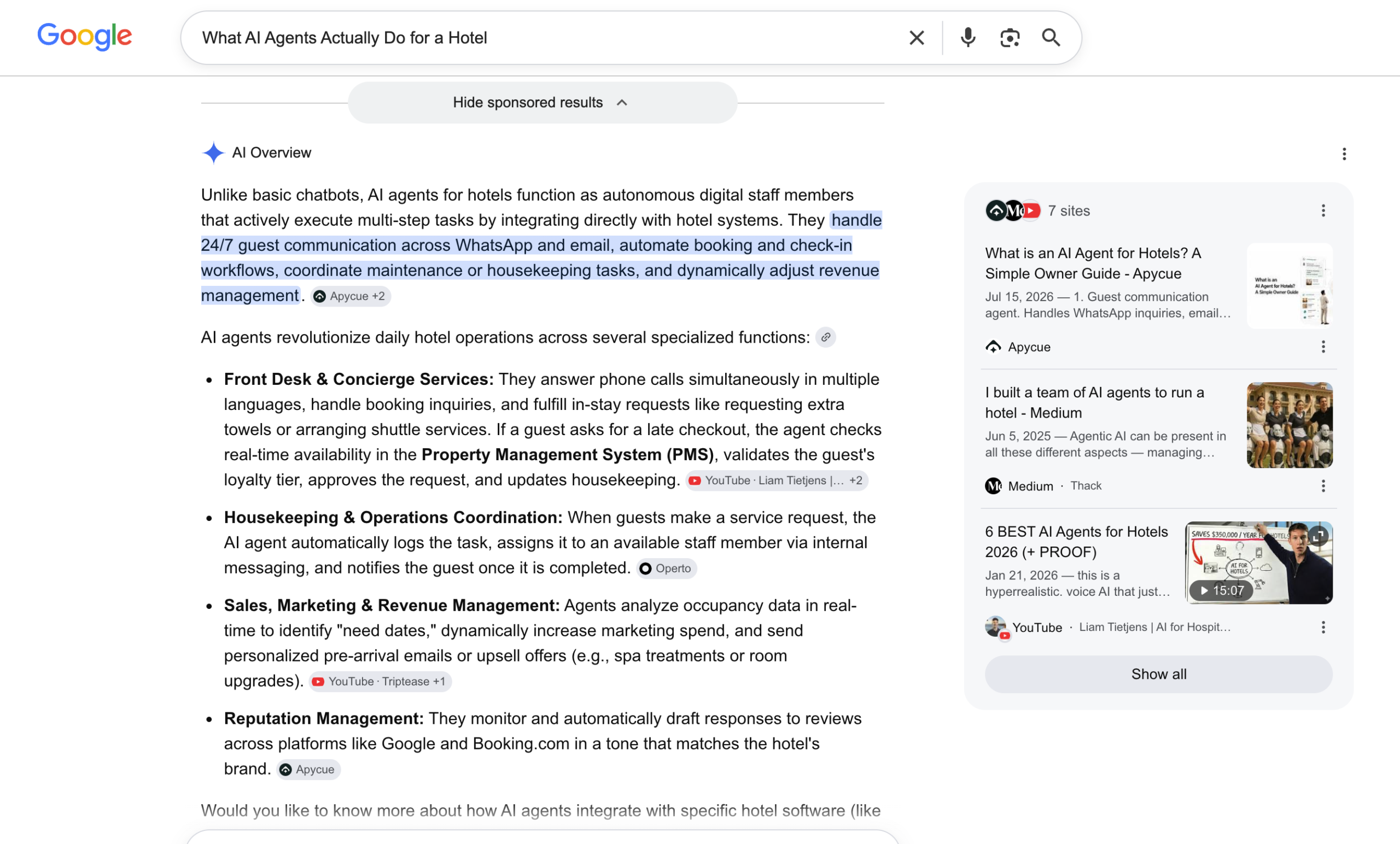
1. First question: what do AI agents do for a hotel?
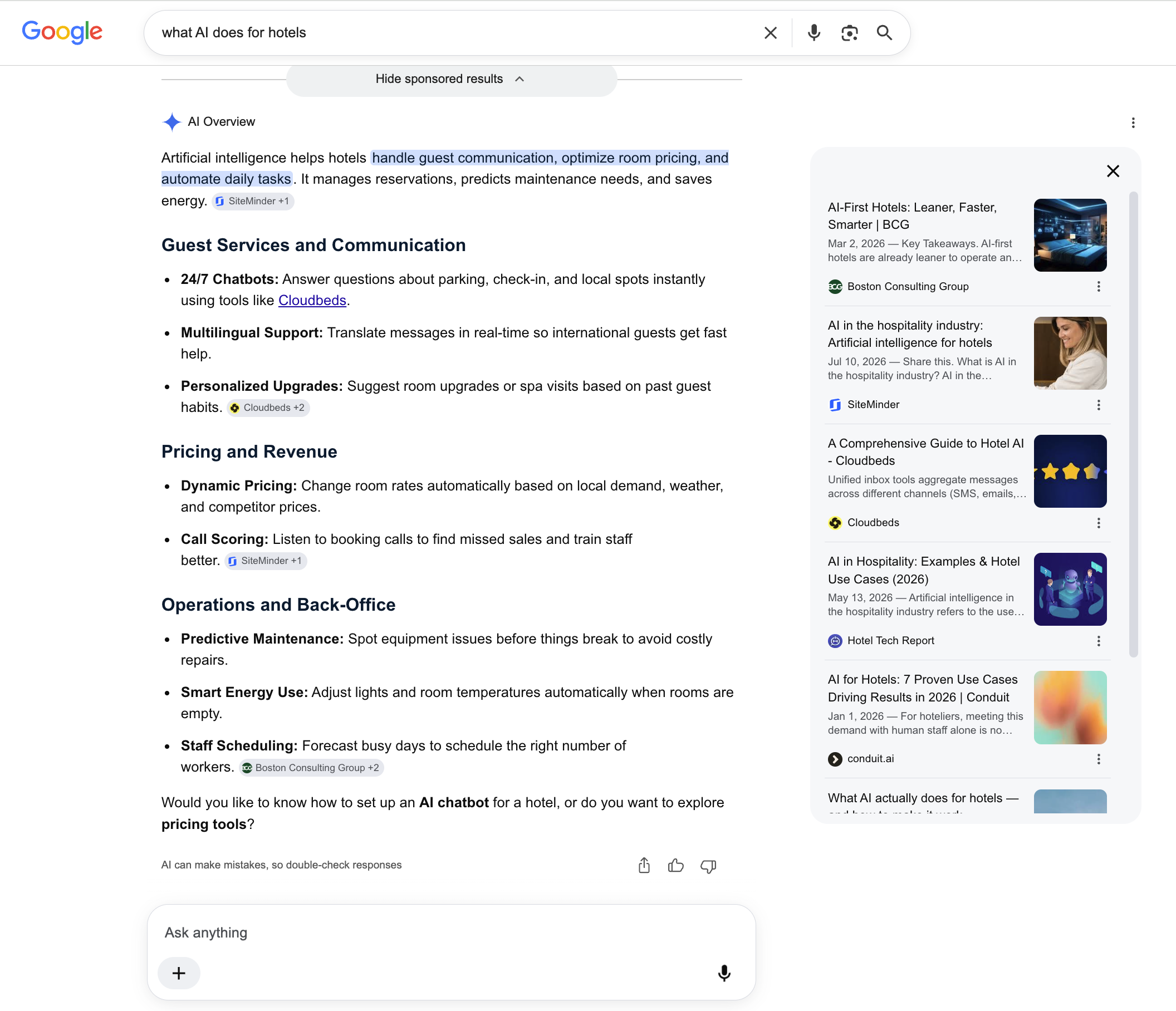
The AI Overview answered before a single source appeared. In substance: AI agents are autonomous digital staff members that plug into hotel systems and execute multi-step tasks — round-the-clock guest communication on WhatsApp and email, booking and check-in workflows, housekeeping and maintenance coordination, dynamic revenue management. Then four tidy categories: front desk and concierge (multilingual calls, late-checkout approvals validated against loyalty tier), housekeeping (log the task, assign it, notify the guest), sales and revenue (identify need dates, send upsell offers), and reputation (draft review replies in the hotel’s brand voice).
Fine, as far as it goes. This is a description of what the market currently ships.
2. Second question: what should they be doing?
So we asked the better question. Not what these agents do — what they should be capable of.
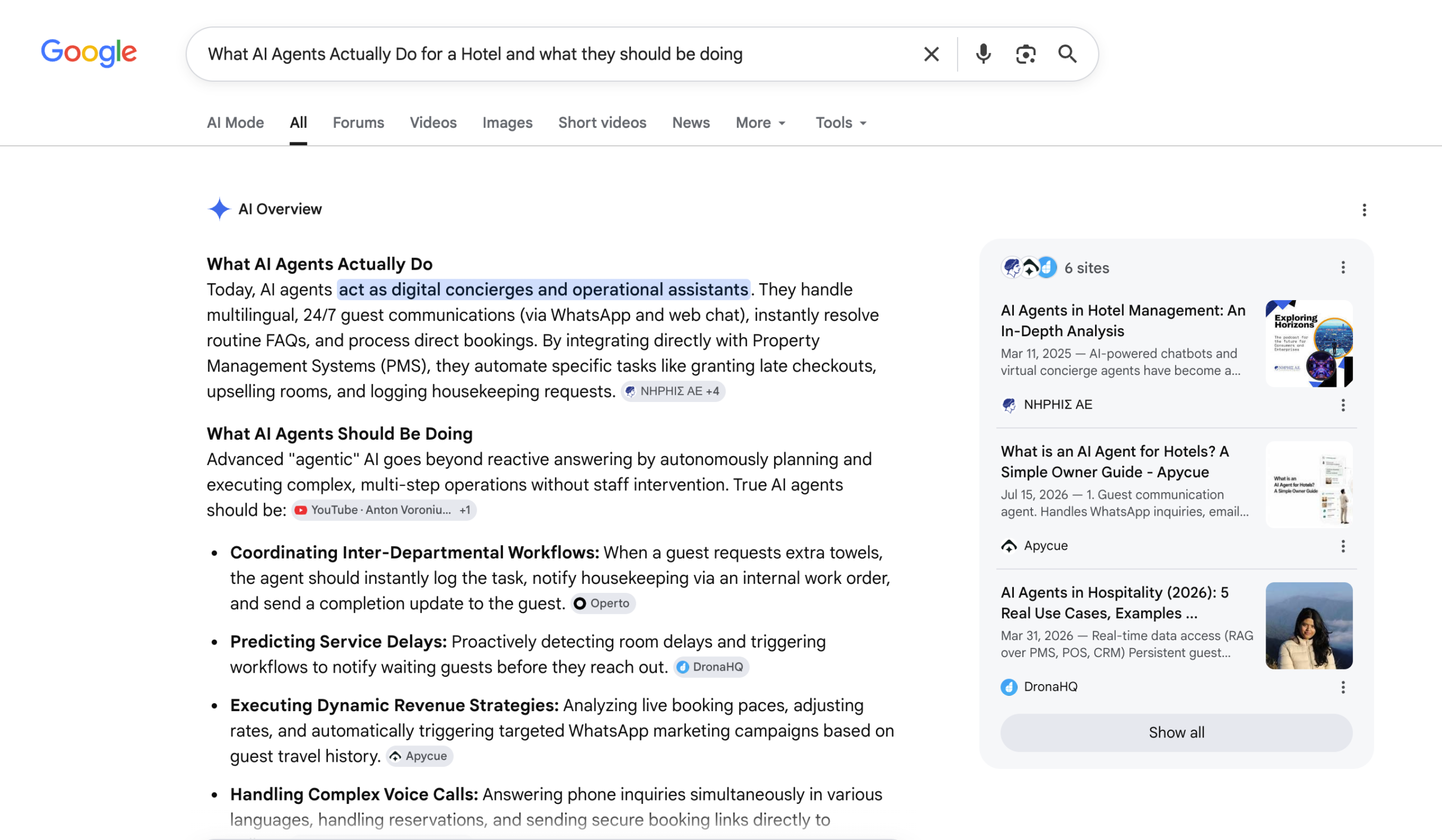
Google split its answer under two headings, “What AI Agents Actually Do” and “What AI Agents Should Be Doing.” The first half repeated the list above.
The second half opened with a definition that genuinely reaches for something: agentic AI, it said, goes beyond reactive answering by autonomously planning and executing complex, multi-step operations without staff intervention.
Then came its examples of what agents should be doing:
- A guest requests extra towels; the agent logs the task, notifies housekeeping via an internal work order, and sends the guest a completion update.
- It detects room-readiness delays and notifies waiting guests before they ask.
- It analyses booking pace, adjusts rates, and triggers marketing campaigns.
- It answers phone calls in several languages and sends booking links to callers.
Read that again, because it is the aspirational half. Asked what this technology should be able to do, the answer is a towel request routed to housekeeping.
What actually went wrong here
Three things, and only one of them is about Google.
The definition reached higher than the examples could follow.
“Autonomously planning and executing complex operations” is a real idea pointing at something real. Every example underneath it is a workflow — a lookup, a rule, a notification. That gap is the most honest thing in the whole answer: it shows a category that can sense something exists above its current ceiling but cannot describe what.
Every example, in both halves, sits after the booking exists.
Towels, room readiness, rate adjustments, call handling. The conversation that determines whether a guest books you at all — the enquiry, the questions, the hesitation, the comparison against three other properties — appears nowhere. Not in what agents do, and not in what they should do.
And the answer’s foundations are visible. Google lists its sources, and they repay a look. Across the two searches the cited material was: vendor blogs (Apycue, Operto, DronaHQ, Triptease), a Medium post titled “I built a team of AI agents to run a hotel,” a podcast episode, and YouTube videos — including one called “6 BEST AI Agents for Hotels 2026 (+ PROOF),” whose thumbnail promises savings of $350,000 a year.
That is the evidence base from which a hotel manager is being told what their technology should be capable of. It contains no independent research, no trade-press analysis, and — most tellingly — no hotel operator describing what actually happens in their building. It is vendors describing their own roadmaps, a listicle video with a revenue figure in the thumbnail, and somebody’s side project.
There are two smaller tells worth noting. The Overview describes these agents as “digital concierges” and then, in the same breath, describes nothing a concierge does — it lists task automation. And it says AI agents “revolutionize” daily hotel operations, which is the register of the source material bleeding straight through into what is presented as a neutral summary. On the plainer query, the whole thing sat below a block of sponsored results.
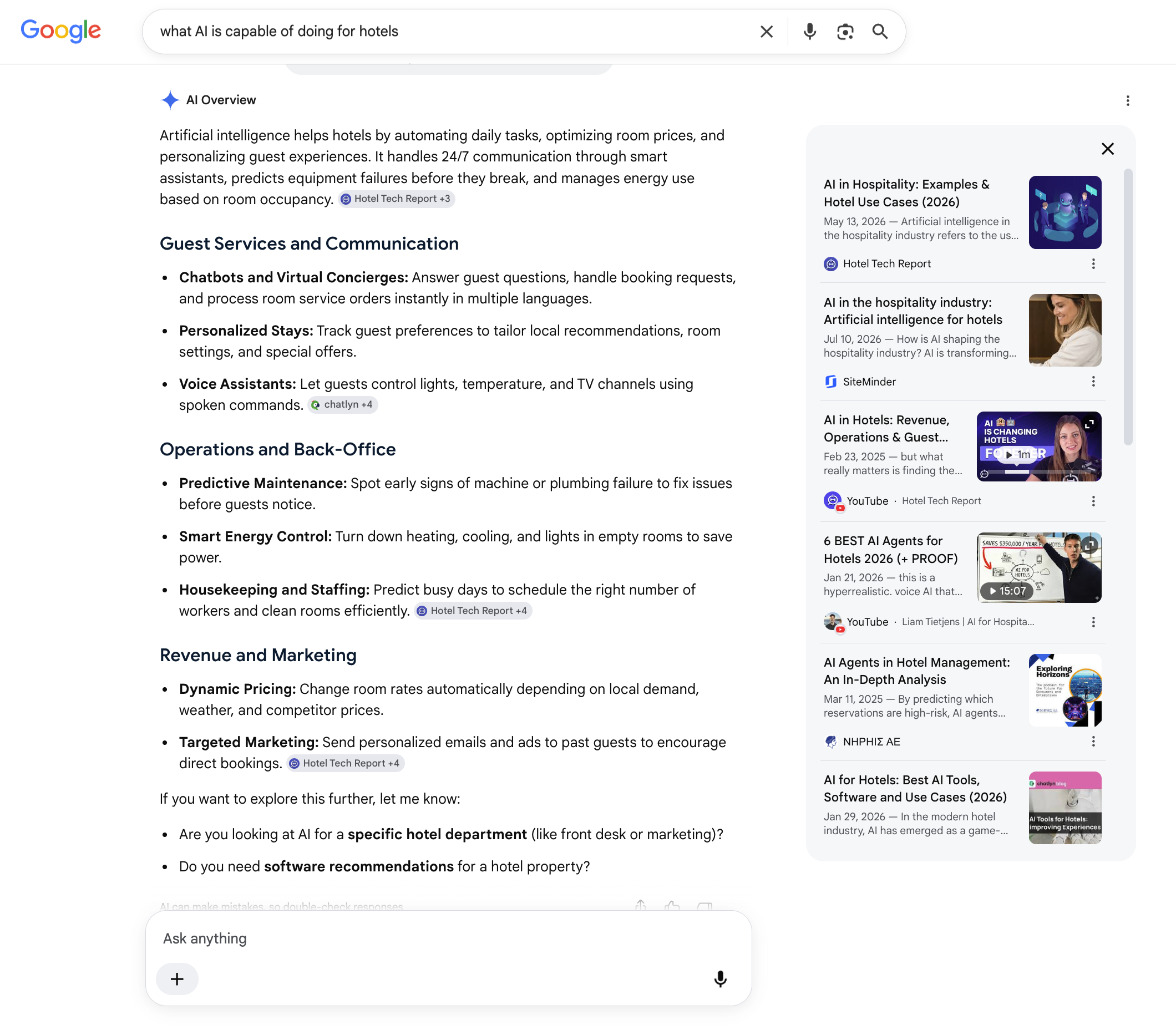
Both answers closed by qualifying us as a lead. One asked which operational bottleneck we wanted to solve and which property management system we run; the other offered to explain how AI agents integrate with specific hotel software. A strategic question, resolved within one screen into vendor discovery.
Why this happens — and why it matters for your decisions
Google did not invent any of this. It summarised, accurately, what the hospitality technology industry has published about itself. That is the uncomfortable part. The answer is not a distortion of the category’s thinking; it is a faithful reflection of it, ceiling included.
Which points at something worth internalising well beyond this one search.
An AI Overview is a consensus engine.
It reads what has been published and returns the middle of it, weighted by trust and quality signals that reward volume, domain authority and repetition — not insight, and certainly not operating experience. When a topic is mature and well documented, that works. When a topic is young and the published record consists mostly of vendors describing their own roadmaps, plus video content optimised for clicks, the consensus is the marketing. The source list above is not a glitch; it is what currently exists to summarise.
So for a question like “what does this technology do,” you get a serviceable answer. For a question like “what should it be able to do” — the question that actually precedes an investment — you get the same answer wearing an aspirational label. The default answer describes the category’s floor and calls it the frontier.
For a hotel manager deciding where to put money and attention next year, that is precisely the wrong input, delivered with maximum authority and zero friction.
What to do instead
Ask questions consensus can’t flatten.
Not “what do AI agents do for hotels,” which returns the market’s brochure. Instead: where does my hotel lose money in ways I currently cannot see? Then: what would something have to be capable of to close that gap? Then, and only then, go and find out which products can actually do it.
That sequence is harder and slower. It also cannot be answered by a summary of what everyone has already written, which is exactly why it is worth your time.
Sum up
We asked Google what AI agents should be able to do for a hotel. It answered with the same post-booking automation it had just described them already doing, topping out at routing a towel request — assembled from vendor blogs, a Medium side project and YouTube videos, and closing by asking which PMS we use.
That is not really a failure of Google. It is an accurate summary of what an industry has published about itself, and an unusually clear picture of that industry’s ceiling.
The lesson for any hotel manager: a default AI answer tells you what a category can already do. It will never tell you what it should be able to do — and the gap between those two is where your unrealised revenue is sitting.
We wrote the answer we think that question deserves: [AI Agents for Hotels: What They Do, and What They Should Be Able to Do →]